When will solid-state batteries be in cars?
This is the question on everybody's lips.
And the honest answer? Not yet, but sooner than you might think.
Development is accelerating across the industry, with several major manufacturers now moving beyond the research phase into prototype and pilot production.
Here’s where things stand:
Toyota – 2027-2028
Toyota has been one of the most vocal advocates for solid-state technology, and has confirmed its programme is on schedule for a 2027-2028 launch.
Early claims suggested ranges of up to 745 miles, though the company is now placing greater emphasis on lifespan, with its solid-state cells expected to last up to four times longer than conventional lithium-ion batteries.
If Toyota delivers on schedule, it would represent the first mass-market solid-state EV from a mainstream manufacturer.
Stellantis – 2026 demonstration
In April 2025, Stellantis – the parent company of brands like Peugeot, Citroën, Vauxhall and Fiat – validated solid-state cells with an energy density of 375Wh/kg, capable of charging from 15% to 90% in 18 minutes.
Stellantis has planned demonstration fleets for this year, making Stellantis one of the furthest along in terms of real-world testing.
Honda – late 2020s
Honda has opened a pilot production line in Japan and expects solid-state batteries to appear in production vehicles in the second half of this decade.
There’s no confirmation yet on a more specific launch window.
BYD – post-2030
Despite leading the current EV market, BYD is taking a more measured approach to solid-state technology.
The company has indicated that demonstrations could begin in 2027, but mass production isn’t expected until after 2030.
NIO and IM Motors – semi-solid-state, available in China
It’s worth noting that semi-solid-state batteries – a hybrid approach that uses both liquid and solid electrolytes – are already in production in China.
NIO and IM Motors both offer models with ranges exceeding 620 miles using this tech.
These aren’t fully solid-state, but they do demonstrate that the direction of travel is real and moving fast.
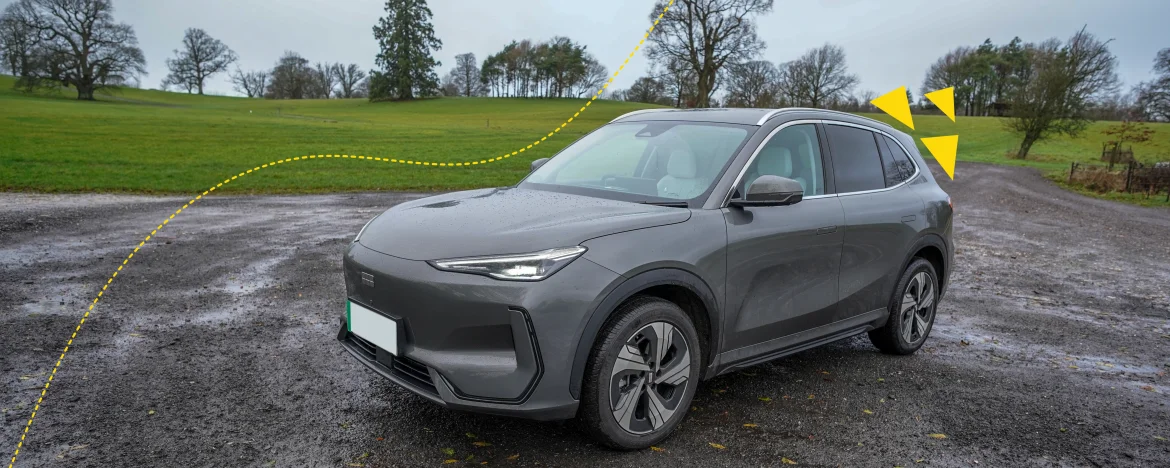
If you want to take advantage of this tech for yourself, the MG IM6 utilises a semi-solid-state pack for its 100kWh battery, giving it an official range of 388 miles (WLTP Comb) and charging speeds of up to 396kW.
However, fully solid-state batteries aren’t available in the UK yet.
And when solid-state EVs do reach the market, early availability is likely to be limited, and pricing will reflect the cost of the tech.
The mainstream moment – where solid-state batteries are standard across a wide range of models at accessible price points – likely won’t happen until the 2030s.